The Short Answer
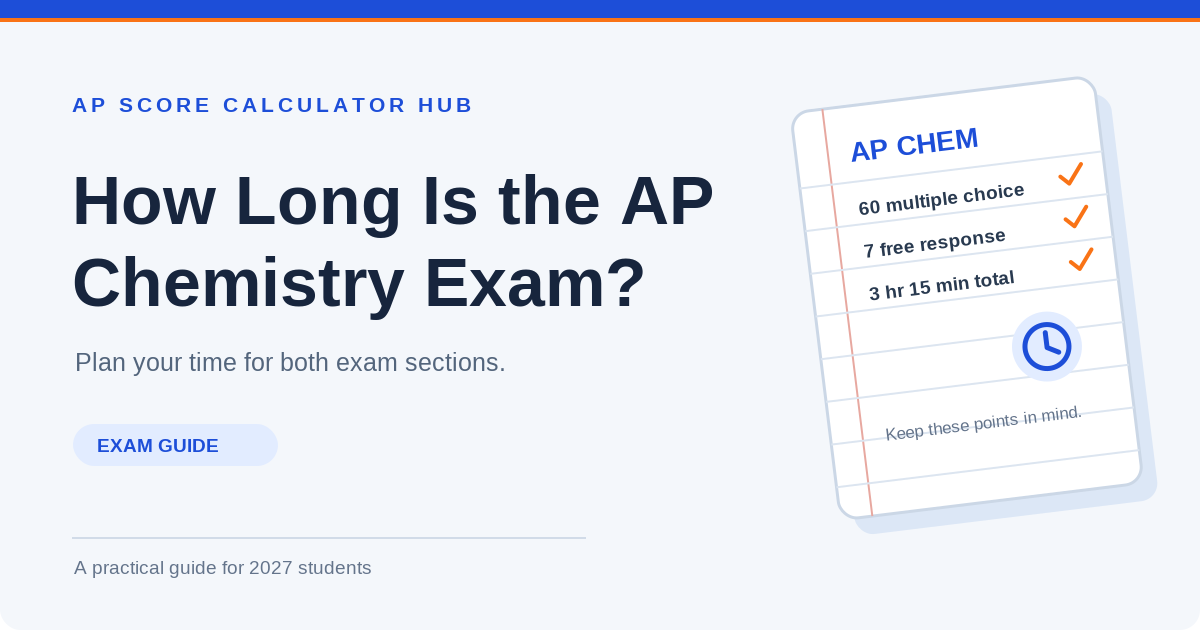
Total testing time: 3 hours 15 minutes (195 minutes). This is one of the longer AP exams - 30 minutes longer than AP Biology.
Section I - Multiple-Choice: 60 questions in 90 minutes (50% of score)
Section II - Free-Response: 7 questions in 105 minutes (50% of score)
- 3 long FRQs x 10 points each = 30 points
- 4 short FRQs x 4 points each = 16 points
- Total FRQ raw points: 46
Including the 10-minute break between sections, plan on about 3 hours 25 minutes of seat time. Add another 30 minutes for check-in, Bluebook login, and proctor instructions. If your exam starts at 8:00 AM local time, plan to be at the testing site from around 7:30 AM until approximately 11:30 AM.
This format has been stable for several years and has not changed for 2027.
| Section | Questions | Testing time |
|---|---|---|
| Multiple choice | 60 questions | 90 minutes |
| Free response | 3 long and 4 short questions | 105 minutes |
| Total | Both sections | 3 hours 15 minutes |
Exam Date and Time for 2027
The AP Chemistry exam is scheduled for Thursday, May 6, 2027, Session 2. Ask your AP coordinator for the local start time, room, and check-in instructions.
AP Chemistry falls in the first exam week. AP Human Geography is Monday, May 3, and AP Government is Tuesday, May 4, 2027; plan your review around any adjacent exams.
Arrive at the testing site at least 30 minutes before start time. You will need to check in with photo ID, log into Bluebook, and complete proctor instructions before the exam begins.
Section I: Multiple-Choice (60 Questions, 90 Minutes)
Section I is 60 multiple-choice questions in 90 minutes. It counts for 50% of your total exam score.
The 60 questions include a mix of stand-alone questions and question sets grouped around a shared stimulus - a graph, data table, experimental setup, particle diagram, or short passage. Expect roughly half the section to be stimulus-based, which takes longer per question than stand-alones.
At 90 minutes for 60 questions, you have an average of 90 seconds per question. That is reasonable for most questions, but multi-step calculations (especially equilibrium and thermodynamics problems) can easily eat 2-3 minutes if you are not efficient.
Content coverage: Questions are distributed across all 6 Big Ideas roughly evenly. Expect around 10 questions per Big Idea. No major topic is "safe to skip."
Pacing target: Complete the first 30 questions in 45-50 minutes, leaving 40-45 minutes for the remaining 30 questions plus 5-10 minutes to review flagged items. Do not spend more than 2 minutes on any single question during your first pass.
Key strategy: Use your calculator actively on MCQ. Unlike AP Psychology or APUSH, you have a calculator here - leverage it for multi-step calculations rather than trying to do them by hand. That is what saves you time.
Section II: Free-Response (7 Questions, 105 Minutes)
Section II gives you 105 minutes (1 hour 45 minutes) for 7 free-response questions. It counts for 50% of your exam score.
The 7 FRQs split into two types with different point values:
3 long-form FRQs (10 points each): Multi-part, often 6-8 subparts each. These anchor around experimental design, multi-step calculations, or complex lab scenarios - titration, equilibrium problems, kinetics experiments, thermodynamics, electrochemistry. Each long FRQ is approximately 15% of your FRQ section score.
4 short-form FRQs (4 points each): More focused, typically 2-4 subparts each. These test specific skills or ideas - a single equilibrium calculation, an acid-base problem, a gas law application. Each short FRQ is approximately 9% of your FRQ section score.
Suggested time allocation:
- Long FRQs: 20-25 minutes each (60-75 minutes total)
- Short FRQs: 7-10 minutes each (28-40 minutes total)
That totals 88-115 minutes. Plan to use the full 105-minute window but do not exceed 25 minutes on any single long FRQ, even if you feel it is incomplete. Moving on to earn points elsewhere beats camping out and leaving others undone.
How to Approach the 3 Long FRQs
Each long FRQ is worth 10 points and tests your ability to navigate complex, multi-step chemistry problems. These are where most of your FRQ section score comes from (30 of 46 total points).
Step 1 (2-3 minutes): Read the entire question and any stimulus - data table, graph, particle diagram, or experimental setup. Identify what is being asked and what is given. Note the units.
Step 2 (1-2 minutes): Outline your approach. If the question has parts a-g, jot down what each part requires. Plan your calculations before starting to write.
Step 3 (15-20 minutes): Work through each subpart systematically. Show your work - partial credit is very common in AP Chem FRQs.
Step 4 (2-3 minutes): Scan your answer. Did you address every subpart? Units correct? Significant figures reasonable?
Key strategies:
- Show all calculations. A correct final answer without work may lose points; incorrect final answer with clear setup often earns partial credit.
- Use the equation sheet actively. CollegeBoard provides pH, equilibrium, thermodynamic, kinetics, and Nernst equations. Reference them rather than guessing.
- Units and significant figures matter. Graders look for correct units on final answers and reasonable sig figs.
- Label particle diagrams clearly. If you draw a particle-level diagram, label species and note any relevant charges.
How to Approach the 4 Short FRQs
Each short FRQ is worth 4 points and tests a focused skill - one equilibrium calculation, one acid-base problem, one gas law application, one stoichiometry or kinetics problem. These are designed to move quickly.
Answer directly. A short FRQ is not the place to review all your knowledge on a topic. Read the prompt, identify what is asked, calculate or explain, move on.
Time allocation: 7-10 minutes each. That is enough for the calculation plus brief justification or explanation - not enough for a multi-paragraph response.
Use precise terminology. "The reaction shifts forward because of Le Chatelier's principle with increased reactant concentration" is better than "more reactant makes more product."
Skip and return if stuck. If a short FRQ involves a concept you blanked on (for example, you forgot how to set up a buffer problem), move to the next one. Do not spend 15 minutes on a 4-point question while leaving others untouched.
The Calculator Policy
AP Chemistry allows calculators on both the multiple-choice and free-response sections.
Allowed: four-function, scientific, and graphing calculators that meet the current College Board calculator policy. Its approved graphing list includes some CAS models, such as listed TI-89, TI-Nspire CAS, and HP Prime models.
Not allowed: phones, smartwatches, calculator sharing, and models or features prohibited by the current policy. Check your exact model before exam day.
Practice with the calculator you will bring. Know its logarithm and exponential functions, and bring a permitted backup if you have one.
The Equation Sheet
CollegeBoard provides a printed equation sheet with every AP Chemistry exam (and a Bluebook digital version for digital exams). You do not need to memorize equations - but you must know how and when to use each one.
Key equations on the sheet:
Equilibrium: Kc and Kp expressions, Q (reaction quotient) for comparison to K
Acid-base and pH: pH = -log[H+], Kw = 1.0 x 10^-14, Ka/Kb expressions, Henderson-Hasselbalch (pH = pKa + log([A-]/[HA]))
Thermodynamics: dG = dH - TdS, dGdeg = -RT ln K, dG = dGdeg + RT ln Q
Kinetics: Rate laws (rate = k[A]^n), integrated first-order and second-order forms, Arrhenius equation (k = Ae^(-Ea/RT))
Electrochemistry: Nernst equation (E = Edeg - (RT/nF) ln Q)
Also provided: a periodic table with atomic masses, and gas constant R in multiple units.
Critical skill: Recognize which equation applies. A common mistake is picking the wrong equation because the problem superficially looks familiar. Practice problems deliberately so you know which equations apply when.
The 6 Big Ideas and 6 Science Practices
AP Chemistry is organized around 6 Big Ideas that integrate the course content:
Big Idea 1: Atomic structure and properties (electrons, periodic trends)
Big Idea 2: Molecular and ionic compound structure and properties (bonding, intermolecular forces)
Big Idea 3: Intermolecular forces and properties (liquids, gases, solutions)
Big Idea 4: Chemical reactions (stoichiometry, redox, acid-base)
Big Idea 5: Kinetics (rate laws, mechanisms, activation energy)
Big Idea 6: Thermodynamics and equilibrium (enthalpy, entropy, Gibbs, Keq, Ka/Kb)
Layered on top are 6 Science Practices that appear across every question type:
SP1: Models and representations (particle diagrams, graphs)
SP2: Question and method (experimental design)
SP3: Representing data and phenomena
SP4: Model analysis
SP5: Mathematical routines (quantitative problem-solving)
SP6: Argumentation (claim, evidence, reasoning)
What is heavily tested: Mathematical routines (SP5) and argumentation (SP6) dominate both MCQ and FRQ sections, especially in equilibrium, acid-base, and thermodynamics. Experimental design and data analysis (SP2-SP4) appear heavily in long FRQs and stimulus-based MCQ sets. If you want to maximize your score, drill quantitative problem-solving relentlessly.
2026 Score Distribution
2026 AP Chemistry results: College Board reports 15% earned a 5, 31% a 4, 30% a 3, 18% a 2, and 6% a 1. College Board reports 75% earned a 3 or higher; individual percentages are rounded.
These percentages describe scores awarded, not raw-score cutoffs. They do not tell you how many MCQs you need correct for a 5.
Use the official score-distribution table for the latest year, and try the AP Chemistry calculator for a clearly labeled practice estimate.
What to Bring on Exam Day
Follow the supply list from your AP coordinator. Bring your required identification and exam credentials, a charged testing device if your school requires one, and a permitted calculator.
Check the current calculator policy for your exact model. CAS capability alone does not disqualify a listed calculator.
Leave phones, smartwatches, notes, and personal formula sheets outside the testing area. College Board supplies the exam reference materials.
Confirm the digital or hybrid exam-day procedure with your school before the exam.
Common Misconceptions
“Any calculator is fine.” Check the current approved-model list and prohibited features. Some CAS models are allowed.
“Memorizing the periodic table is enough.” The exam asks you to apply trends, quantitative relationships, and lab reasoning.
“The free-response section is all calculations.” Scoring rubrics also reward explanations, experimental design, and particle-level reasoning.
“A score distribution gives me a raw cutoff.” It shows how many students earned each AP score, not the raw points needed.
Key Equations You Must Know How to Use
You will have the equation sheet on test day, but you need fluency with when and how to apply each equation:
Equilibrium: Write Kc and Kp expressions from chemical equations. Connect K to Le Chatelier - know how changing concentration, pressure, temperature, or volume shifts equilibrium. Compare Q to K to predict reaction direction.
Acid-base / pH: Calculate pH from [H+], convert between Ka and pKa, use Henderson-Hasselbalch for buffer problems. Know how to set up weak acid or weak base ICE tables.
Thermodynamics: Use dG = dH - TdS to predict spontaneity. Use dGdeg = -RT ln K to connect free energy and equilibrium. Know when each equation applies.
Kinetics: Determine reaction order from initial rates data. Use integrated rate laws for first- and second-order reactions. Use Arrhenius for activation energy calculations.
Electrochemistry: Calculate non-standard cell potentials using the Nernst equation. Connect Edeg, dGdeg, and K for a single reaction.
Practice recognizing which equation applies to each problem. The equation sheet is useless if you do not know which one to pick up.
Final preparation for the 2027 exam
About two weeks before: Practice multi-step calculations and explanation-based FRQs with the formula sheet you will use on exam day. Review errors from one timed practice set.
In the final three days: Review the errors you already found, confirm your Bluebook or exam-day setup with your AP coordinator, and avoid starting a new full-length course review.
The night before: Pack permitted supplies, check your room and session, and allow time for sleep. Follow your school’s instructions about arrival and breaks.
On exam day: Arrive by the time your AP coordinator specifies, follow the proctor’s directions, and keep your section pacing plan in mind.
Frequently Asked Questions
How many questions are on the AP Chemistry exam?
The AP Chemistry exam has 60 multiple-choice questions (Section I) and 7 free-response questions (Section II). The 7 FRQs split into 3 long-form questions (10 points each) and 4 short-form questions (4 points each), for a total of 67 questions overall.
Is AP Chemistry hard?
The 2026 AP Chemistry score distribution shows 75% earned a 3 or higher and 15% earned a 5. The exam requires quantitative problem-solving and clear explanations.
What is on the AP Chemistry exam?
The exam covers 6 Big Ideas: atomic structure, molecular and ionic compound structure, intermolecular forces, chemical reactions, kinetics, and thermodynamics and equilibrium. It emphasizes mathematical problem-solving, experimental design, and particulate-level reasoning through the 6 Science Practices.
How is AP Chemistry scored?
Section I (60 MCQs, 90 minutes) counts for 50% of your score. Section II (7 FRQs, 105 minutes) counts for 50%. Long FRQs are worth 10 points each (3 x 10 = 30 points); short FRQs are worth 4 points each (4 x 4 = 16 points). Raw scores are combined and scaled to the 1-5 AP scale each year.
Do you get a calculator on AP Chem?
Yes. Approved scientific and graphing calculators are permitted on both sections. Some CAS models appear on the approved list; check the current College Board calculator policy for your exact model.
What percentage is a 5 on AP Chem?
In the official 2026 AP Chemistry distribution, 15% earned a 5. This is the share of students awarded a 5, not the raw percentage of points needed.
How long is the AP Chemistry exam in 2027?
The AP Chemistry exam in 2027 is 3 hours 15 minutes of testing time (195 minutes): 90 minutes for Section I MCQ and 105 minutes for Section II FRQ, with a 10-minute break between sections. Total seat time including check-in is typically 3 hours 30 minutes to 4 hours.