The Short Answer
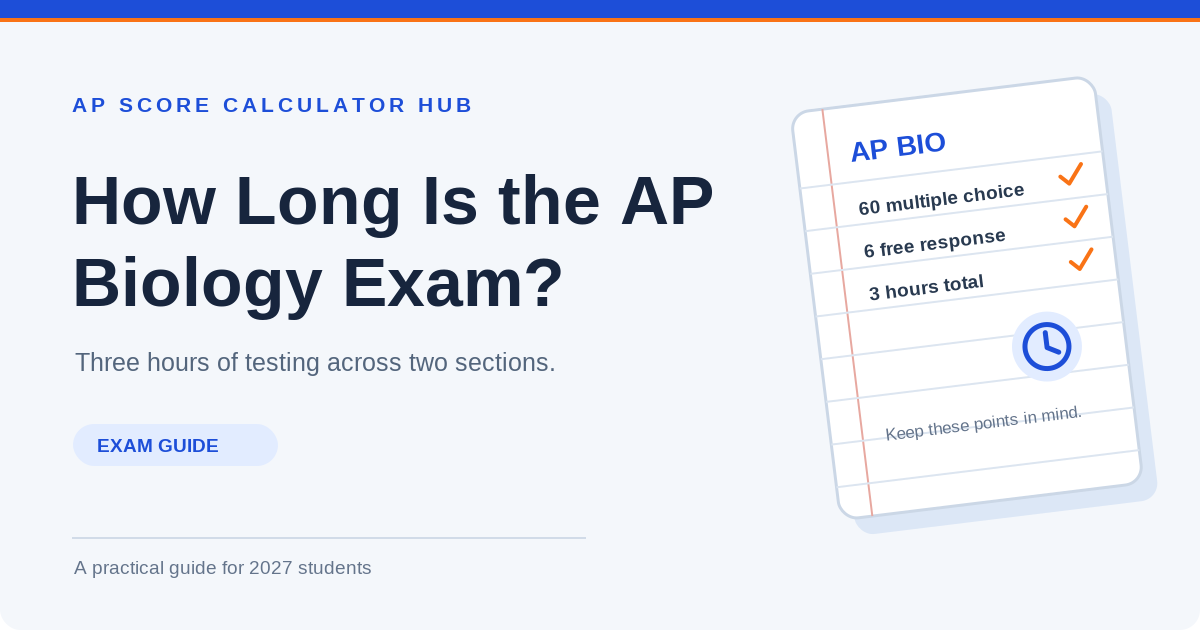
Total testing time: 3 hours (180 minutes). Split evenly into 90 minutes for Section I (multiple-choice) and 90 minutes for Section II (free-response). Each section is worth exactly 50% of your final score.
Including the 10-minute break between sections, expect about 3 hours 10-15 minutes of seat time. Add another 30 minutes for check-in, Bluebook login, and proctor instructions. If your exam starts at 12:00 PM local time, plan to be at the testing site from roughly 11:30 AM until around 3:30-3:45 PM.
This structure has been stable since the major AP Biology redesign in 2013-2014. No format change has been announced for 2027 - what you are preparing for matches what you will take.
| Section | Questions | Testing time |
|---|---|---|
| Multiple choice | 60 questions | 90 minutes |
| Free response | 2 long and 4 short questions | 90 minutes |
| Total | Both sections | 3 hours |
Exam Date and Time for 2027
The AP Biology exam is scheduled for Monday, May 3, 2027, Session 2. Ask your AP coordinator for the local start time, room, and check-in instructions.
AP Biology is on the first day of the 2027 exam window. Confirm your Session 2 start time and testing location with your AP coordinator.
Arrive at your testing site at least 30 minutes before start time. You will need to check in with photo ID, log into Bluebook (for the MCQ portion), and complete proctor instructions before the exam begins.
Section I: Multiple-Choice (60 Questions, 90 Minutes)
Section I is 60 multiple-choice questions in 90 minutes. It counts for 50% of your total exam score.
The 60 questions include a mix of stand-alone questions and question sets grouped around a shared stimulus - typically a graph, data table, experimental setup, or short passage. Stimulus-based sets take longer to work through because you have to read and interpret the stimulus before answering each question.
At 90 minutes for 60 questions, you have an average of 90 seconds per question. That is more generous than AP Gov (87 sec) or AP Psych (72 sec), but do not let the extra seconds make you complacent - stimulus-based question sets eat time quickly.
MCQ content emphasis: Expect roughly half the questions to involve data analysis, graph interpretation, experimental design, or model-based reasoning. Pure recall questions are a minority. If you have been memorizing vocabulary without practicing data problems, recalibrate.
Section II: Free-Response (6 Questions, 90 Minutes)
The six free-response questions take 90 minutes and count for 50% of the exam score.
Two long questions: 9 points each. They ask you to analyze data, explain biological processes, and justify conclusions.
Four short questions: 4 points each. They focus on targeted analysis and explanation.
The written section has 34 raw points in all. Add your rubric points across all six questions for a practice estimate in the Biology calculator.
Pace yourself across 90 minutes and leave time to answer every subpart.
How to Approach the Long FRQs
The 2 long FRQs are where most students lose points through poor pacing or incomplete answers. These questions test your ability to analyze data, design experiments, and reason through complex biological scenarios.
Step 1 (2-3 minutes): Read the entire question and any accompanying stimulus (graph, table, experimental setup). Underline or mentally note the variables, the measured outcomes, and what the question is actually asking.
Step 2 (1-2 minutes): Briefly outline your answer structure for each part. Know where you are going before you start writing.
Step 3 (15-20 minutes): Answer each part directly. Use specific biological terminology - "active transport," "feedback inhibition," "osmosis," "allopatric speciation." Vague language loses points even when the underlying reasoning is correct.
Step 4 (2-3 minutes): Scan your answer to ensure you addressed every part. A common mistake: skipping part (d) because time ran short on part (c). Partial credit on every part beats full credit on most parts.
Key principle: AP Biology long FRQs are scored on specific rubric points, not essay quality. A focused answer that hits every rubric point scores higher than an elaborate one that misses key terminology.
How to Approach the Short FRQs
The 4 short FRQs reward speed and precision. Each should take about 8-10 minutes total, so there is no room for wandering.
Answer directly, in complete sentences. Bullet-style full sentences often work well - you do not need elaborate paragraphs. "Osmosis is the movement of water across a selectively permeable membrane from a region of low solute concentration to high solute concentration" is exactly the kind of response a short FRQ expects.
Use exact terminology. If the question asks about a specific process, name it with the precise biological term. Short FRQs often have a specific term the graders are looking for. Writing "cells move stuff in and out" instead of "active transport" loses the rubric point even if your underlying understanding is correct.
Do not over-write. A short FRQ is not an opportunity to demonstrate everything you know about the topic. Answer the question as asked, then move on. Extra information does not earn extra points, and it consumes time you need for later questions.
Skip and return if stuck. If a short FRQ involves a concept you blanked on, move to the next one and return at the end if time allows. Do not spend 15 minutes on one short FRQ and leave others untouched.
The Calculator and Formula Sheet
Unlike AP Psychology or AP Government, AP Biology allows calculators. This is a major advantage - and a major testing point.
Calculator policy: Bring an approved four-function calculator with square root or a non-graphing scientific calculator. Bluebook also provides a Desmos scientific calculator. Handheld graphing calculators and phone calculators are not permitted for AP Biology.
Formula sheet: CollegeBoard provides a printed formula sheet with every AP Biology exam. It includes the most common equations tested:
- Chi-square test - chi-square = sum[(O-E)^2/E] - used for testing observed vs expected genetic ratios, ecological data, and other frequency comparisons
- Hardy-Weinberg equations - p^2 + 2pq + q^2 = 1 and p + q = 1 - used for population genetics problems
- Standard deviation and mean - for analyzing sets of experimental data
- Water potential - Psi = Psi_s + Psi_p - used for osmosis and plant biology problems
- pH - pH = -log[H+] - used for buffer and acid-base problems
Practical advice: Do not memorize these formulas - you will have them on test day. But DO know how and when to use each one. A common mistake: recognizing you need chi-square but forgetting how to set up the observed and expected values.
The Four Big Ideas and Seven Science Practices
AP Biology is organized around four Big Ideas that integrate the course content:
Big Idea 1: Evolution. Evolution drives the diversity and unity of life. Includes natural selection, speciation, Hardy-Weinberg equilibrium, and phylogeny.
Big Idea 2: Energy and Metabolism. Biological systems use free energy and molecular building blocks to grow, reproduce, and maintain homeostasis. Includes photosynthesis, cellular respiration, membrane transport, and enzyme regulation.
Big Idea 3: Information Storage and Transmission. Living systems store, retrieve, transmit, and respond to information. Includes DNA, RNA, protein synthesis, gene regulation, and cell signaling.
Big Idea 4: Biological Systems and Interactions. Biological systems interact with complex properties. Includes ecology, population dynamics, and how systems at different levels interact.
Layered on top are seven Science Practices that appear in nearly every exam question: using models and representations, applying mathematical routines (SP2 - this is where chi-square and statistics live), analyzing data (SP3), designing experiments (SP4), interpreting data and arguments (SP5), constructing explanations (SP6), and making connections (SP7).
What is heavily tested: Data analysis (SP3), experimental design (SP4), and mathematical routines (SP2) dominate the FRQs. If you want to maximize your score, prioritize practicing these skills over pure content memorization.
2026 Score Distribution
In the official 2026 AP Biology distribution, 15% earned a 5, 25% a 4, 31% a 3, 21% a 2, and 8% a 1. College Board reports 71% earned a 3 or higher.
These percentages describe final AP scores, not the raw points required for each score.
Use the official table for updates and the Biology calculator for a practice estimate.
What to Bring on Exam Day
Required:
- Government-issued photo ID
- Your AP student ID (provided by your school)
- #2 pencils (for FRQ booklet if administered on paper)
- Black or dark blue pens (for FRQ booklet)
Highly recommended:
- Approved four-function or non-graphing scientific calculator
- Backup calculator batteries
- Water bottle (if school permits)
- Light snack for the break
- Layered clothing
Not allowed:
- Phones, smartwatches, fitness trackers
- Headphones or earbuds
- Notes, textbooks, flashcards, or printed outlines
- Your own formula sheet (CollegeBoard provides one)
- Calculators built into phones or with wireless capability
Hybrid format note: In current administrations, AP Biology MCQs are taken digitally in Bluebook, while FRQs are handwritten in a paper booklet. This means you will switch from device to paper mid-exam. If you have not practiced this hybrid format, ask your AP coordinator for a Bluebook practice session.
Common Misconceptions
"AP Biology is just memorization." False. Roughly half the exam involves data analysis, experimental design, and quantitative reasoning. Students who memorize vocabulary without practicing applied skills typically struggle.
"The exam is pure content knowledge." Misleading. Content is the foundation, but the exam tests how you apply that content to novel scenarios, data, and experiments. A student who knows every textbook term but cannot interpret a graph will not do well.
"I do not need to practice labs." Risky. CollegeBoard recommends 13 inquiry-based labs, and FRQs frequently mirror lab scenarios - experimental design, data analysis, predictions. Students who skipped labs in class often struggle with these FRQs.
"The short FRQs are easy." Half-true. They are shorter and more focused, but they demand precision. Vague answers lose points, and with only 8-10 minutes each, there is no time to ramble.
"Calculator use saves me from statistics." No. You have a formula sheet and calculator, but you need to know when to use chi-square vs standard deviation, which variables are observed vs expected, and how to set up calculations. The tools do not do the thinking for you.
Final preparation for the 2027 exam
About two weeks before: Practice data interpretation, experimental design, and both long and short FRQs. Review the mistakes from a timed practice section.
In the final three days: Review the errors you already found, confirm your Bluebook or exam-day setup with your AP coordinator, and avoid starting a new full-length course review.
The night before: Pack permitted supplies, check your room and session, and allow time for sleep. Follow your school’s instructions about arrival and breaks.
On exam day: Arrive by the time your AP coordinator specifies, follow the proctor’s directions, and keep your section pacing plan in mind.
Frequently Asked Questions
How many questions are on the AP Biology exam?
The AP Biology exam has 60 multiple-choice questions (Section I) and 6 free-response questions (Section II). The 6 FRQs split into 2 long-form questions and 4 short-form questions, for a total of 66 questions overall.
Is the AP Biology exam hard?
The official 2026 distribution shows 71% earned a 3 or higher and 15% earned a 5. The exam emphasizes data interpretation, experimental reasoning, and clear biological explanations.
What is on the AP Biology exam?
The exam covers four Big Ideas: evolution, energy and metabolism, information storage and transmission, and biological systems. It emphasizes data analysis, experimental design, and reasoning (the seven Science Practices) through both MCQs and FRQs.
How is AP Biology scored?
Section I (60 MCQs, 90 minutes) counts for 50% of your score. Section II (6 FRQs, 90 minutes) counts for 50%. Raw points from both sections are combined and scaled to the 1-5 AP scale, with a 3 or higher considered passing.
What percentage is a 5 on AP Bio?
In the 2026 official AP Biology score distribution, 15% of test takers earned a 5. This is a share of final scores, not the raw percentage required.
Do you get a calculator on AP Bio?
Yes. An approved four-function calculator with square root or a non-graphing scientific calculator is permitted. Bluebook also provides a Desmos scientific calculator. Handheld graphing calculators and phone calculators are not allowed. Check the current College Board calculator policy before exam day.
How long is the AP Biology exam in 2027?
The AP Biology exam is 3 hours of testing time: 90 minutes for Section I (MCQ) and 90 minutes for Section II (FRQ), with a 10-minute break between sections. Total seat time including check-in is typically 3 hours 15 minutes to 3 hours 45 minutes.