The Short Answer
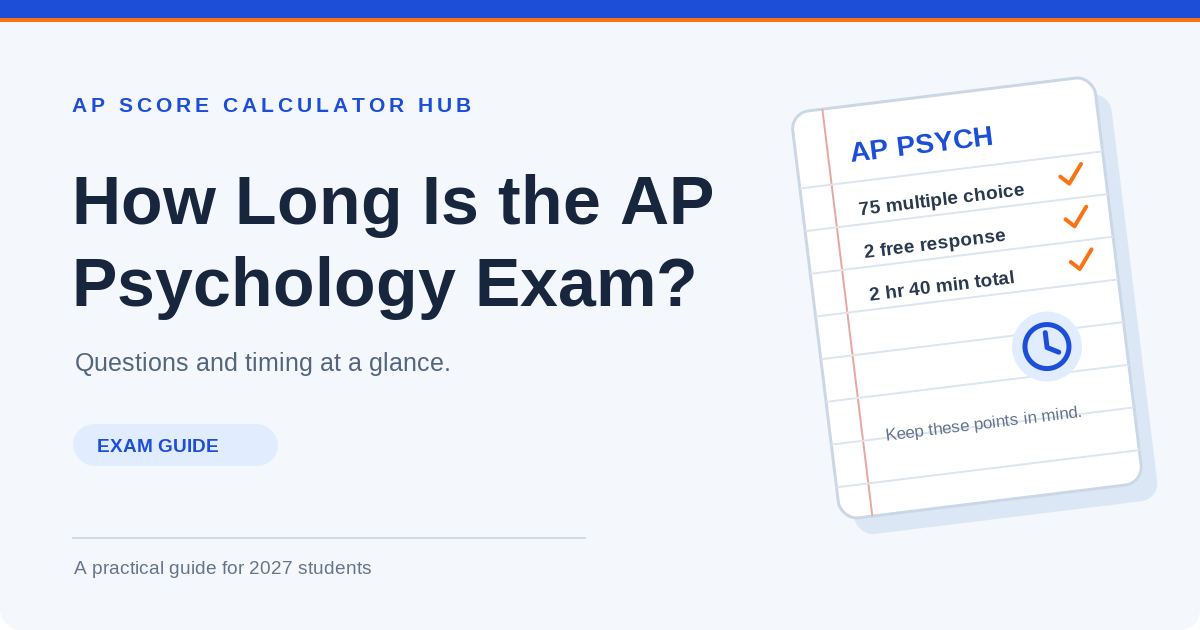
Total testing time: 2 hours 40 minutes (160 minutes). That splits into 90 minutes for Section I (multiple-choice) and 70 minutes for Section II (free-response), with a short break between sections.
Allow additional time for check-in, Bluebook setup, proctor instructions, and any scheduled break. Your AP coordinator will tell you when to arrive and when your local session begins.
Important: this is the post-redesign format, updated for the 2024-2025 school year and continuing through 2027. If you are studying from materials that describe "2 hours, 100 MCQs, 2 short-answer FRQs" - stop. That is the old format and will mislead your timing practice.
| Section | Questions | Testing time |
|---|---|---|
| Multiple choice | 75 questions | 90 minutes |
| Free response | 2 questions: AAQ and EBQ | 70 minutes |
| Total | Both sections | 2 hours 40 minutes |
Exam Date and Time for 2027
The AP Psychology exam is scheduled for Friday, May 14, 2027, Session 2. Ask your AP coordinator for the local start time, room, and check-in instructions.
AP Psychology is on the final day of the regular 2027 exam window. Use the extra preparation time to practice the AAQ and EBQ under timed conditions.
Follow your AP coordinator’s arrival and identification instructions. The exam is completed in the Bluebook testing app, so check your device and login requirements ahead of time.
Why the Format Changed: The 2024 Redesign
CollegeBoard significantly redesigned AP Psychology starting with the 2024-2025 school year. The May 2027 exam is the third year of the new format. Here is what changed:
Total exam time: Increased from 2 hours to 2 hours 40 minutes.
Multiple-choice section: Reduced from 100 questions in 70 minutes to 75 questions in 90 minutes. Students now have more time per question, not less.
Free-response section: Extended from 50 minutes to 70 minutes, with completely new FRQ types.
FRQ format: The old "two short-answer-style essay questions" are gone. They have been replaced by one Article Analysis Question (AAQ) and one Evidence-Based Question (EBQ) - both designed around data interpretation, research methods, and applying psychological concepts to scenarios.
Current section weighting: MCQ is 66.7% of your score and FRQ is 33.3%, according to College Board’s current exam overview.
The redesign shifts emphasis from pure content recall toward science practices - reading research, interpreting graphs, and constructing evidence-based arguments. If your study materials feel "too definitional" (just vocabulary flashcards), they are probably outdated.
Why You Will See Conflicting Information Online
Thousands of AP Psychology study resources were created before 2024, and many are still indexed in Google's top results. If you search "how long is the AP Psychology exam" you will see a mix of old and current information.
Signs a resource is outdated:
- Says the exam is "2 hours" total (it is now 2 hours 40 minutes)
- Describes 100 MCQs (it is now 75)
- Describes the old essay prompts instead of the AAQ and EBQ
- Does not mention Bluebook digital testing
Signs a resource is current:
- References the 2024 redesign
- Describes AAQ and EBQ FRQ formats
- Mentions Bluebook digital testing
For the most authoritative current information, go straight to the CollegeBoard AP Psychology assessment page. That is the definitive source for the current format.
Section I: Multiple-Choice (75 Questions, 90 Minutes)
Section I is 75 multiple-choice questions in 90 minutes. It counts for 66.7% (two-thirds) of your total exam score - which means if you nail the MCQ section, you are set up well even if FRQs go sideways.
At 90 minutes for 75 questions, you have about 72 seconds per question on average - slightly more than a minute each. That is a reasonable pace for well-prepared students, but tight enough that you cannot linger on any single question.
The MCQ content emphasis in the new format: Fewer pure-vocabulary questions and more questions that ask you to interpret research scenarios, apply concepts to real-world situations, analyze experimental designs, or evaluate data. You will still see straightforward concept questions, but expect a meaningful chunk to involve stimulus material (brief descriptions of studies, graphs, or scenarios).
Pacing target: Complete roughly 35-40 questions in the first 40-45 minutes. That leaves you 45-50 minutes for the remaining questions plus any you marked to return to. Do not guess when you have time to think - but do not spend 3 minutes on a single question.
Section II: Free-Response (2 Questions, 70 Minutes)
Section II gives you 70 minutes for 2 free-response questions. The two current question types are the Article Analysis Question and Evidence-Based Question; practice with their current scoring guidelines.
The two questions are always these specific types:
FRQ 1: Article Analysis Question (AAQ). College Board provides one summarized peer-reviewed source. You can earn up to 7 points across six parts covering research method, variables, statistics, ethics, generalizability, and application.
FRQ 2: Evidence-Based Question (EBQ). College Board provides three summarized peer-reviewed sources on a common topic. You can earn up to 7 points for a claim, evidence from the sources, and reasoning that applies psychology content.
Since FRQ is only 33.3% of your score, even a weak FRQ section does not destroy your exam if your MCQs were strong. But do not phone it in - most 4s and 5s come from students who perform competently on both sections.
How to Approach the Article Analysis Question (AAQ)
The AAQ begins with one summarized peer-reviewed source and has six scored parts. Read the source carefully and answer each part directly using the research details provided.
Step 1 (2-3 minutes): Read the stimulus carefully. Underline or mentally note the key variables, the main finding, and any methodological details (sample size, correlational vs experimental, etc.).
Step 2 (2-3 minutes): Identify the core finding in your own words - for example, "the study shows a positive correlation between sleep quality and memory performance."
Step 3 (20-25 minutes): Answer the specific parts. Common AAQ asks include identifying the research method, discussing a limitation, explaining the finding using a psychological concept (memory consolidation, operational definition, etc.), and evaluating ethics or generalizability.
Key strategy: Use specific psychology terminology every time. "The study found a connection" is weak. "The study demonstrates a positive correlation consistent with the encoding-specificity principle" is strong. Specificity earns points.
How to Approach the Evidence-Based Question (EBQ)
The EBQ gives you three summarized peer-reviewed sources on a shared topic and asks you to build a supported claim. It has the same 7-point maximum as the AAQ.
Step 1 (3-5 minutes): Read the prompt and all three sources. Identify the question, the evidence in each source, and any psychology concepts that apply.
Step 2 (2 minutes): Write a clear, one-sentence thesis. For example: "Maria's behavior is best explained by operant conditioning, specifically through positive reinforcement and intermittent reinforcement schedules."
Step 3 (25-30 minutes): Develop 2-3 supporting paragraphs, each focused on one psychological concept. For each concept: name it, define it briefly, apply it directly to the scenario with specific details from the stimulus, and explain why it fits.
Key strategy: The rubric rewards application more than recall. You can recite the definition of classical conditioning perfectly, but if you do not apply it to specific details in the scenario, you lose points. Always link concept to evidence.
Common Time Management Mistakes
Mistake 1: Studying with the old format's timing. The old 100-question section allowed about 42 seconds per question. The current 75-question section allows about 72 seconds per question on average. Use current practice questions and timing.
Mistake 2: Treating AAQ and EBQ as equivalent. They require different strategies: the AAQ analyzes one source across six parts, while the EBQ builds a claim from three sources.
Mistake 3: Writing too much. FRQs are scored on specific rubric points, not essay quality. A focused, well-organized response that hits every rubric requirement scores higher than a sprawling essay that buries the analysis.
Mistake 4: Ignoring the stimulus for AAQ. The AAQ wants you to analyze what was given to you. Do not pivot to general psychology knowledge if it ignores the specific data in front of you.
Mistake 5: Ignoring the school’s break instructions. Follow the proctor’s schedule between sections and use any break to reset before the free-response section.
What to Bring on Exam Day
Required:
- Items and identification specified by your AP coordinator
- A charged, approved device if your school requires you to bring one
- Your College Board login details if your coordinator instructs you to have them
Recommended:
- Water bottle (if school permits)
- Light snack for the break (granola bar, banana, nut mix)
- Layered clothing (test rooms run cold)
- Watch without internet or audible alarm
Not allowed:
- Phones, smartwatches, fitness trackers
- Headphones or earbuds
- Notes, textbooks, flashcards, or printed outlines
- Scratch paper (provided by proctor if needed)
- Calculators (not permitted for AP Psychology)
The AP Psychology exam is fully digital through Bluebook. If you have been practicing with Bluebook throughout the year, this is familiar. If you have not yet used Bluebook, contact your AP coordinator immediately - you can practice in the app before exam day.
Common Misconceptions
"The exam is still 2 hours long." False. The current format is 2 hours 40 minutes. If your practice exams are timed at 2 hours, they are from the old format.
"AP Psych is an easy AP." Difficulty depends on your preparation. The current exam tests research analysis, evidence, and application as well as content knowledge.
"The content is completely different now." Half true. The core units are the same (biological bases, sensation and perception, learning, cognition, development, motivation and emotion, personality, clinical and abnormal, and social psychology). What changed is that questions now emphasize application and data analysis rather than pure recall.
"I can skip the AAQ/EBQ practice because they are just essays." Dangerous. AAQ and EBQ have very specific rubrics that reward structured responses. Students who have not practiced these specific FRQ types lose easy points.
"Old YouTube tutorials and practice PDFs are still fine." Risky. Pre-2024 materials may help with content, but their practice tests, timing, and FRQ format are wrong. Use them for vocabulary review only.
Final preparation for the 2027 exam
About two weeks before: Write at least one timed Article Analysis Question and one timed Evidence-Based Question. Use the current scoring guidelines to check your answers.
In the final three days: Review the errors you already found, confirm your Bluebook or exam-day setup with your AP coordinator, and avoid starting a new full-length course review.
The night before: Pack permitted supplies, check your room and session, and allow time for sleep. Follow your school’s instructions about arrival and breaks.
On exam day: Arrive by the time your AP coordinator specifies, follow the proctor’s directions, and keep your section pacing plan in mind.
Frequently Asked Questions
How many questions are on the AP Psychology exam?
The current AP Psychology exam has 75 multiple-choice questions (Section I) and 2 free-response questions (Section II) - specifically 1 Article Analysis Question and 1 Evidence-Based Question. This is the post-2024 redesign format used for May 2027.
Is the AP Psychology exam hard?
The current format asks you to apply psychology concepts and analyze research evidence. Students who rely only on vocabulary memorization may find the AAQ and EBQ challenging; practice with current College Board questions and scoring guidance.
What is on the AP Psychology exam?
The exam covers core psychology units: biological bases of behavior, sensation and perception, learning, cognition, development, motivation and emotion, personality, clinical and abnormal psychology, and social psychology. The redesigned format emphasizes applying these concepts to research scenarios and data rather than defining terms.
How is AP Psychology scored?
Section I (75 MCQs) counts for 66.7% of your total score. Section II (2 FRQs) counts for 33.3%. Raw points from both sections are combined and scaled to the 1-5 AP scale, with a 3 or higher considered passing.
What changed about the AP Psychology exam?
The 2024 redesign lengthened the exam from 2 hours to 2 hours 40 minutes, reduced MCQs from 100 to 75, increased MCQ time from 70 to 90 minutes, and replaced the old short-answer FRQs with 1 Article Analysis Question (AAQ) and 1 Evidence-Based Question (EBQ). The new format emphasizes data analysis and evidence-based reasoning.
How long is the AP Psychology exam in 2027?
The AP Psychology exam in 2027 has 2 hours 40 minutes of testing time: 90 minutes for multiple choice and 70 minutes for free response. Allow additional time for check-in, Bluebook setup, and your school’s break schedule.
What time does the AP Psychology exam start?
College Board schedules AP Psychology for Friday, May 14, 2027, Session 2. Your AP coordinator will confirm the local start time.