The Short Answer
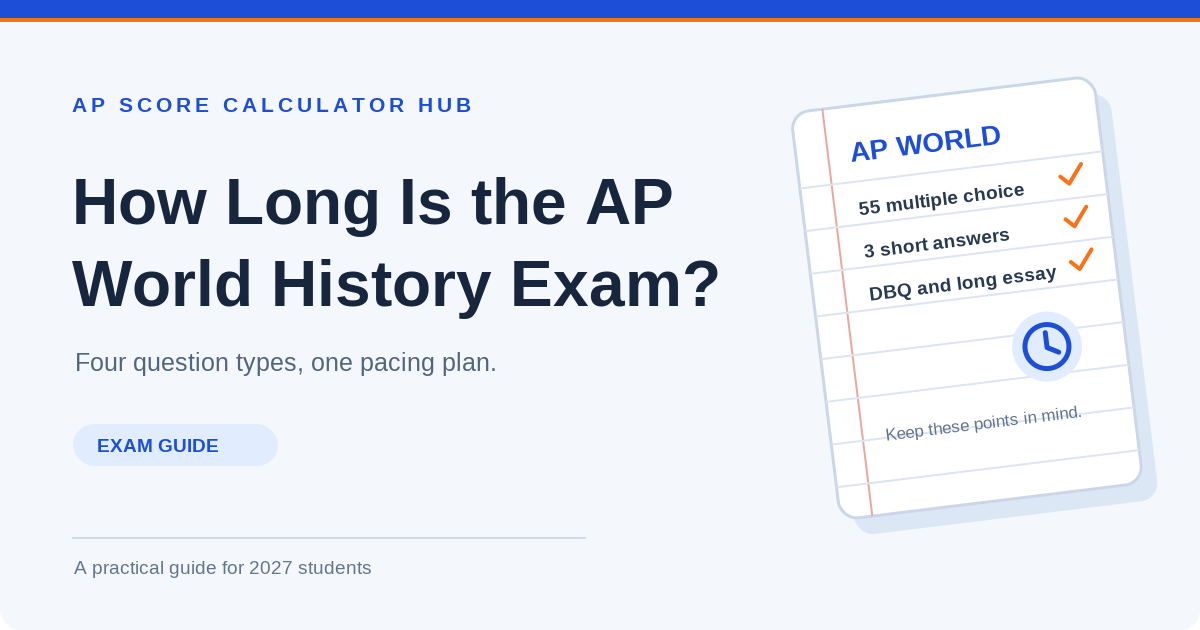
Total testing time: 3 hours 15 minutes (195 minutes). This is identical to AP US History. The structure breaks into two sections and four question types:
Section I (95 minutes total, 60% of score):
- Part A: 55 multiple-choice questions in 55 minutes (40% of score)
- Part B: 3 short-answer questions in 40 minutes (20% of score)
Section II (100 minutes total, 40% of score):
- Part A: 1 Document-Based Question in 60 minutes including a 15-minute reading period (25% of score)
- Part B: 1 Long Essay Question in 40 minutes (15% of score)
Including possible school-scheduled breaks, expect 3 hours 25-35 minutes of total seat time. Add 30 minutes for check-in and proctor instructions.
If you have friends taking APUSH, the format is the same. What changes is the content. AP World covers global history from 1200 CE to today, across Europe, the Americas, Africa, Asia, and Oceania.
| Question type | Amount | Testing time |
|---|---|---|
| Multiple choice | 55 questions | 55 minutes |
| Short answer | 3 questions | 40 minutes |
| Document-based question | 1 essay, including reading time | 60 minutes |
| Long essay | 1 essay | 40 minutes |
Exam Date and Time for 2027
The AP World History: Modern exam is scheduled for Thursday, May 6, 2027, Session 1. Ask your AP coordinator for the local start time, room, and check-in instructions.
AP World History is in the first exam week. AP Government is Tuesday, May 4, and AP US History is Friday, May 7, 2027, so history and civics students may have several exams close together.
Arrive at your testing site at least 30 minutes before start time. You will need to check in with photo ID, log into Bluebook (for digital administrations), and complete proctor instructions before the exam begins.
What AP World Covers (And Why That Matters)
AP World History: Modern covers 1200 CE to the present - roughly 800 years of global history. The course is organized into nine units that flow chronologically and thematically:
Unit 1: The Global Tapestry (1200-1450)
Unit 2: Networks of Exchange (1200-1450)
Unit 3: Land-Based Empires (1450-1750)
Unit 4: Transoceanic Interconnections (1450-1750)
Unit 5: Revolutions (1750-1900)
Unit 6: Consequences of Industrialization (1750-1900)
Unit 7: Global Conflict (1900-Present)
Unit 8: Cold War and Decolonization (1900-Present)
Unit 9: Globalization (1900-Present)
Geographic coverage: The exam tests all regions - Europe, the Americas, Africa, Asia, and Oceania. No region is "safe to skip." Students who focus only on European history (because it is the most familiar) tend to struggle with questions on East Asian dynasties, West African kingdoms, Andean civilizations, or Pacific trade networks.
What this means for MCQs: Many questions are explicitly comparative or transregional. A single question might ask you to compare state formation in Ming China and the Ottoman Empire, or analyze trade patterns across the Indian Ocean world. Prepare to think globally, not nationally.
Section I Part A: Multiple-Choice (55 Questions, 55 Minutes)
Section I Part A is 55 multiple-choice questions in 55 minutes. It counts for 40% of your total exam score - the single largest weighting of any section.
Like APUSH, AP World MCQs are almost entirely stimulus-based. You will see questions grouped around documents, images, political cartoons, maps, charts, or tables - often primary sources from the time period being tested. Each stimulus typically anchors 2-4 questions that explore different aspects.
Content coverage: Questions are distributed across all nine units, roughly evenly. Expect about 6 questions per unit. Do not skew your study toward 20th-century topics just because they feel more accessible.
Time per question: Exactly 1 minute per question on average. Move efficiently. If a stimulus is from a region or period you are weaker on, flag the question and return to it rather than spending 2-3 minutes trying to decode an unfamiliar source.
Pacing target: Complete the first 28-30 questions in 30 minutes, leaving 25 minutes for remaining questions plus flagged ones. Answer every question - there is no guessing penalty.
Section I Part B: Short-Answer Questions (3 Questions, 40 Minutes)
Section I Part B is 3 short-answer questions (SAQs) in 40 minutes. It counts for 20% of your total exam score.
Each SAQ has 3 parts (a, b, c), and you must answer all parts of all three questions. Prompts typically ask for causation, comparison, continuity/change, contextualization, or sourcing in a global historical context. Total raw points across the three SAQs is typically 9-12.
Current format note: AP World used to have 4 SAQs with a choice between two options for the final question. The current format is 3 required SAQs with no choice. If your practice materials show 4 SAQs, they are outdated.
Time allocation: Roughly 12-14 minutes per SAQ. This gives you enough time for 3-4 focused sentences per subpart - not enough for full paragraphs.
How to approach SAQs:
- Answer each part directly with a clear topic sentence addressing the prompt
- Use specific historical evidence - named people, events, empires, or processes - not vague generalizations
- Bullet-style full sentences work, as long as they are coherent
- Do not write introductions or conclusions
- If a subpart asks you to "explain," include why or how - not just what
Section II Part A: The Document-Based Question (60 Minutes)
The DBQ is a 60-minute block: 15-minute reading period + 45-minute writing period. It counts for 25% of your total exam score.
Structure: You get a prompt plus 7 documents (text excerpts, political cartoons, charts, images, maps) drawn from multiple regions and time periods. Your job is to write a thesis-driven essay that uses at least 6 of 7 documents plus outside evidence.
AP World DBQs are typically transregional or comparative. A DBQ might ask you to analyze responses to industrialization across three continents, or evaluate how trade networks transformed societies across the Indian Ocean world. Expect documents from multiple regions - do not assume the prompt is "about Europe."
The 15-minute reading period:
- Read all 7 documents and annotate them
- Note the source of each document (who wrote it, when, for what audience)
- Make outline notes on scratch paper or in margins
- You CANNOT start writing the essay during the 15 minutes
- You CANNOT jump to the LEQ
The 45-minute writing period:
- First 5 minutes: finalize thesis, confirm document groupings
- Next 35 minutes: write introduction, body paragraphs, conclusion
- Last 5 minutes: proofread and add any missing rubric elements
The DBQ rubric is identical to APUSH (7 points). This means practice strategies transfer directly from APUSH prep resources - but your content knowledge must be global.
The DBQ 7-Point Rubric
The AP World DBQ uses the same 7-point rubric as APUSH:
1 point - Thesis: A clear, historically plausible argument that directly responds to the prompt with a specific line of reasoning.
1 point - Contextualization: Situate your argument in a broader historical context - what was happening globally before, during, or after the events in question.
2 points - Evidence from documents:
- 1 point for using at least 6 of 7 documents as evidence
- 1 point for describing or elaborating on the documents, not just listing them
1 point - Evidence beyond the documents: Include at least one piece of specific, relevant outside evidence from your world history knowledge that is NOT from the 7 documents.
1 point - Sourcing/analysis: Analyze point of view, purpose, audience, or historical context of at least 3 documents. Explain why the source matters, not just what it says.
1 point - Complex understanding: Demonstrate nuance - acknowledge counterevidence, connect across regions or time periods, or recognize multiple causes. This is the hardest point to earn.
World-specific tip: Your "evidence beyond documents" should come from a region or period different from the documents to show breadth of knowledge. If all 7 documents are from 1750-1900 Europe, your outside evidence might be from Qing China or colonial Latin America.
Section II Part B: The Long Essay Question (40 Minutes)
The LEQ is one 40-minute essay and counts for 15% of the exam score.
For the 2027 exam, College Board specifies one required broad LEQ prompt. You select a relevant historical development within that prompt; you do not choose among separate LEQ questions.
Spend 5–10 minutes selecting evidence and outlining a defensible thesis, about 25–30 minutes writing, then use the remaining minutes to check that the response addresses the prompt.
Practice building an argument from specific historical evidence without relying on documents.
The LEQ 6-Point Rubric
Same 6-point rubric as APUSH:
1 point - Thesis: Clear, historically plausible thesis with a specific line of reasoning.
1 point - Contextualization: Place your argument in a broader historical context.
2 points - Evidence:
- 1 point for relevant historical evidence related to the topic
- 1 point for specific evidence that effectively supports your thesis
1 point - Reasoning: Use a historical reasoning process (causation, comparison, continuity/change, or synthesis).
1 point - Complex understanding: Demonstrate nuanced, sophisticated reasoning. Same difficulty as DBQ - hardest point to earn.
How AP World Differs From APUSH
Identical (do not worry about these):
- Total exam length: 3 hours 15 minutes
- Section structure: MCQ (55Q, 55m, 40%), SAQ (3Q, 40m, 20%), DBQ (60m, 25%), LEQ (40m, 15%)
- DBQ 7-point rubric and LEQ 6-point rubric
- 9 Historical Thinking Skills (contextualization, causation, comparison, continuity/change, sourcing, argumentation, synthesis, interpretation, periodization)
- General pacing strategies
Different (this is where preparation diverges):
Scope: APUSH is US-centric (Colonial era through present). AP World is global (1200 CE-present) across all regions.
Focus: AP World emphasizes cross-regional comparison, trade networks, transoceanic connections, and global processes. APUSH emphasizes internal US development and its international interactions.
Content difficulty: AP World has more breadth (more regions, longer time span) but often less depth per topic. APUSH has narrower geographic scope but more detailed content.
Study strategy implication: AP World students must learn to identify patterns across regions, not just memorize details of one country. If you cannot compare industrialization in Britain vs Japan, or independence movements in Latin America vs Africa, you will struggle on the comparative FRQs.
Time Management Strategy
MCQ (55 questions, 55 minutes):
- 1 minute per question average
- Finish first 28-30 questions in 30 minutes
- Flag weak-region questions and return at the end
- Answer every question (no penalty for guessing)
SAQ (3 questions, 40 minutes):
- 12-14 minutes per SAQ
- 3-4 minutes per subpart (a/b/c)
- Be concise - SAQs are not mini-essays
DBQ (60 minutes total):
- First 15 minutes: read all 7 documents, annotate, outline thesis
- Next 30 minutes: write body paragraphs with document integration and outside evidence
- Final 10-15 minutes: introduction, conclusion, and proofreading
- Aim for 5+ rubric points - getting a 7/7 is rare under time pressure
LEQ (40 minutes):
- First 5-10 minutes: choose relevant historical evidence and outline your thesis
- Next 25-28 minutes: write
- Last 3-5 minutes: proofread and check the rubric
2026 Score Distribution
2026 AP World History: Modern results: College Board reports 14% earned a 5, 36% a 4, 16% a 3, 26% a 2, and 8% a 1. About 66% earned a 3 or higher.
These are subject-level outcomes, not raw-score cutoffs. Exam format changes can also limit direct comparisons across years.
See the official distribution and use the AP World History calculator only as a practice estimate.
What to Bring on Exam Day
The 2027 AP World History: Modern exam is fully digital in Bluebook. Follow your AP coordinator’s instructions for your testing device and identification.
Bring the materials your school specifies. Phones, smartwatches, notes, and calculators are not allowed during the exam.
Practice typing a DBQ and LEQ in Bluebook so your timing plan reflects the actual interface.
Common Misconceptions
"AP World is too much content to cover." Partially true in volume, but misleading in strategy. The exam rewards patterns and processes more than memorizing every empire. Students who focus on themes (trade networks, state formation, industrialization, decolonization) do better than students who try to memorize every civilization in detail.
"I need to know every civilization." False. You need to know major empires, regions, and transitions in each unit - but the exam tests understanding of processes, not catalog-style recall. You can miss questions about obscure polities and still score a 5.
"The DBQ is mostly about Europe." False. AP World DBQs are deliberately transregional, often with documents from 3-4 continents. If you only studied European history, you will struggle. Build breadth across all regions.
"The LEQ is easier than the DBQ." Debatable. The LEQ is less document-heavy, but you must produce all evidence from memory. Students who struggle to recall specific examples often find the LEQ harder.
"I can skip 15th-century content and focus on modern history." Risky. Units 1-2 (1200-1450) appear on the exam. Students who ignore pre-1450 content lose easy points on MCQs and may get stuck with an LEQ prompt they cannot answer.
Content Emphasis: What Gets Tested Most
All nine units appear on the exam, but some are tested more heavily in FRQs:
Most common DBQ/LEQ themes:
- Revolutions (Unit 5) - industrial, political, and social revolutions
- Industrialization and imperialism (Units 4-6) - their global consequences
- Global Conflict (Unit 7) - World Wars, Cold War origins
- Decolonization (Unit 8) - independence movements across Asia and Africa
- Globalization (Unit 9) - modern trade, migration, cultural exchange
Key themes (CED-aligned):
Governance (empires, revolutions, state formation, authoritarianism, democracy), Economic systems (trade networks, mercantilism, capitalism, socialism, global markets), Cultural developments (religions, philosophies, intellectual movements), Social interactions (class, race, gender, migration, imperialism), Technology and innovation (transportation, communication, industrial tech), Human-environment interaction (resource use, agriculture, climate, disease, urbanization).
What this means: Practice tracing themes across regions and time periods. A strong AP World student can compare industrial development in Britain, Japan, and Russia - or trace the decolonization of Southeast Asia, sub-Saharan Africa, and the Caribbean. Narrative knowledge of one region is not enough.
Final preparation for the 2027 exam
About two weeks before: Practice one DBQ outline, one LEQ outline, and a timed source-based MCQ set. Review evidence across periods and regions rather than memorizing dates alone.
In the final three days: Review the errors you already found, confirm your Bluebook or exam-day setup with your AP coordinator, and avoid starting a new full-length course review.
The night before: Pack permitted supplies, check your room and session, and allow time for sleep. Follow your school’s instructions about arrival and breaks.
On exam day: Arrive by the time your AP coordinator specifies, follow the proctor’s directions, and keep your section pacing plan in mind.
Frequently Asked Questions
How many questions are on the AP World History exam?
The AP World History: Modern exam has 55 multiple-choice questions, 3 short-answer questions, 1 Document-Based Question, and 1 Long Essay Question - for a total of 60 discrete prompts across 4 question types.
Is AP World History hard?
The 2026 AP World History: Modern distribution shows 66% earned a 3 or higher and 14% earned a 5. The exam spans global history from 1200 to the present; use the current rubric and timed practice to judge your readiness.
What time period does AP World cover?
AP World History: Modern covers 1200 CE to the present. The course is organized into 9 units spanning global empires, trade networks, revolutions, industrialization, World Wars, Cold War, decolonization, and globalization. All world regions are tested.
How is AP World scored?
Section weights: MCQ 40%, SAQ 20%, DBQ 25%, LEQ 15%. The DBQ is scored on a 7-point rubric and the LEQ on a 6-point rubric. Raw scores from all sections are combined and scaled to the 1-5 AP scale each year.
What is the difference between APUSH and AP World?
The exam structure and timing are identical - both are 3 hours 15 minutes with the same 4 question types (MCQ, SAQ, DBQ, LEQ) and identical rubrics. What differs is the content: APUSH focuses on United States history, while AP World covers global history from 1200 CE to the present across all world regions.
How long is the AP World DBQ?
The AP World DBQ is a 60-minute block consisting of a 15-minute reading period followed by 45 minutes of writing time. You must read 7 documents drawn from multiple regions and write a thesis-driven essay using at least 6 of them plus outside evidence.
How long is the AP World History exam in 2027?
The AP World History: Modern exam in 2027 is 3 hours 15 minutes of testing time. Total seat time including check-in and any breaks is typically 3 hours 45 minutes to 4 hours.